Menu
.png)
Today, brands measure “share of searches.” Tomorrow, they must also measure “share of prompts”—how often your brand appears in AI-generated recommendations for the most common questions and use cases. This is the new frontier of the digital shelf. This blog breaks down the fundamentals of AEO, GEO and how it’s all connected with the digital shelf.
Agentic Commerce has introduced a new wave of acronyms for marketers—AEO (Answer Engine Optimization) and GEO (Generative Engine Optimization) among them. While these terms can feel overwhelming, they ultimately center on a single core concept: providing AI agents with the complete, structured* and actionable information they need to recommend your products over competitors.
*Structured data for AI refers to highly organized information that is easily searchable and retrievable by machines. It is formatted in a way that is predictable and consistent, often displayed in rows and columns.
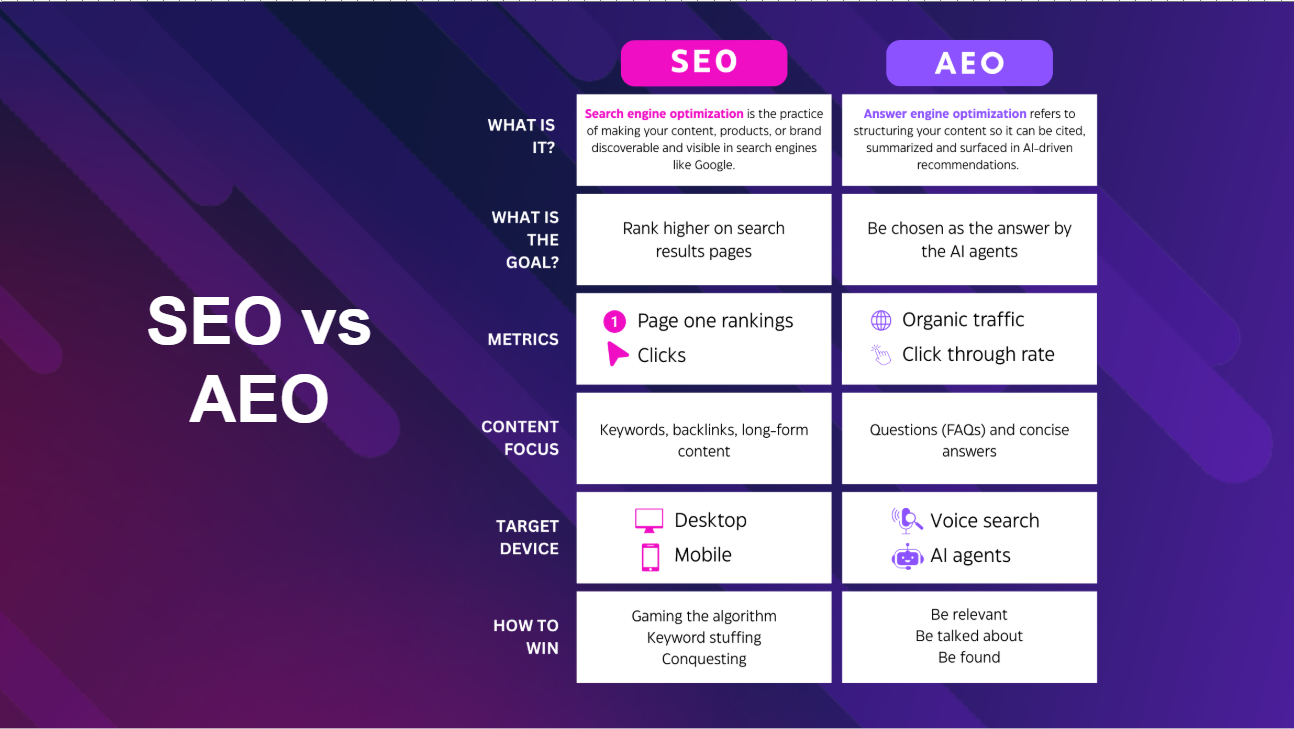
Because of the similar language, GEO/AEO is often confused with SEO (Search Engine Optimization), but they are fundamentally different disciplines.
SEO focuses on optimizing your product pages and content for retailer search engines (the search bar on the top of the page) (e.g., Amazon, Walmart, Target). These algorithms rely on a narrower and more rules-based set of signals—keywords, product titles, image quality, conversion performance, relevancy scoring and customer reviews—to determine rankings.
GEO/AEO, by contrast, focuses on optimizing for AI agents and large language models (LLMs). These models are far more sophisticated and draw from a broader universe of structured and unstructured data. They don’t simply “rank” keywords—they interpret, synthesize and reason across product information, reviews, supporting content, brand authority and even consumer context. The goal is to ensure the AI has every data point, cue and justification it needs to choose your product as the best recommendation in any given scenario.
Both matter—and ideally, you should construct your content operations workflows to address both SEO AND AEO/GEO needs at the same time, versus creating separated and fragmented processes, or ignoring SEO altogether.
As showcased during the Publicis Commerce webinar, Profitero+ is already building AI Commerce Visibility – a new metric that measures a brand’s share of voice across the prompts consumers are expected to ask LLMs like Rufus (also known as Alexa for Shopping), Sparky, and ChatGPT.
This metric will integrate into existing SEO and content optimization workflows to provide brands with a unified way to optimize for consumers, algorithms and AI agents together.
First and foremost, digital shelf analytics remains the backbone of eCommerce performance.
The fundamentals do not change:
Brands need digital shelf data more, not less. Because digital shelf fundamentals are important to agentic as well as human shoppers, Profitero+ must be deeply embedded across all teams influencing:
________________________________________________________________________________________________________
Agentic shoppers operate differently from traditional search algorithms. Visibility is no longer determined solely by rank, but by whether a product meets the standards AI agents apply when assessing relevance, context and confidence.
This distinction is already evident in the data. An early Profitero+ analysis of 36k Amazon products found that only 18% of products on page 1 of traditional search results also appeared in Rufus results. This means that even high-ranking products aren’t guaranteed visibility. The Rufus AI agent is extremely selective, surfacing only a small fraction of what Amazon’s algorithm ranks highest.
If your digital shelf foundation is weak, agent optimization simply will not work. You cannot win AI-driven discovery if you are losing at the basics.
First, as the saying goes, don’t throw the baby out with the bathwater. Stay true to the fundamentals and make sure you are winning retail search.
Traditional retailer search is not going away. Brands must continue to invest in tools like Content Optimizer to maximize visibility in classic search algorithms while preparing for AI-powered discovery. And brands must use solutions like Shelf Intelligent Media to ensure they’re optimizing campaigns to capitalize on competitor conquesting opportunities that can yield much faster and stronger incremental results, right now.
PIM systems and content syndication platforms like Salsify become even more foundational. Agents are information-hungry; if your structured attributes aren’t complete, you may be invisible. Salsify has already begun syndicating catalogs to ChatGPT.
Additionally, tools like Amazon Sales & Share will play a vital role in helping brands contextualize and measure the bottom-line impact Rufus optimization is having on business outcomes. And automation like Autopilot can quickly optimize back end attributes to resonate with Rufus.
If you're interested in learning more about the role of the digital shelf in Agentic Commerce, feel free to reach out to us here. We can help assess your readiness for the next wave of commerce. We’d love to chat!