Menu
Profitero+ looks at millions of signals every year, spanning product content, retail media, availability, search performance, shopper behavior and omnichannel operations - all to help clients move from insight to action faster. The goal is not to document trends, but to translate them into decisions. One outcome holds true each year: small optimizations that are consistently applied create disproportionate growth.
As a thank you to our clients, partners and industry peers, we’re excited to share Stats Unwrapped 2025 - a curated look at the trends and performance metrics defining success on the digital shelf this year.
This edition exists for you: to surface growth opportunities, spark internal alignment and strengthen the decisions that unlock your 2026 budget and strategy.
These are the numbers shaping the road ahead – and the ones you can use to get there first.
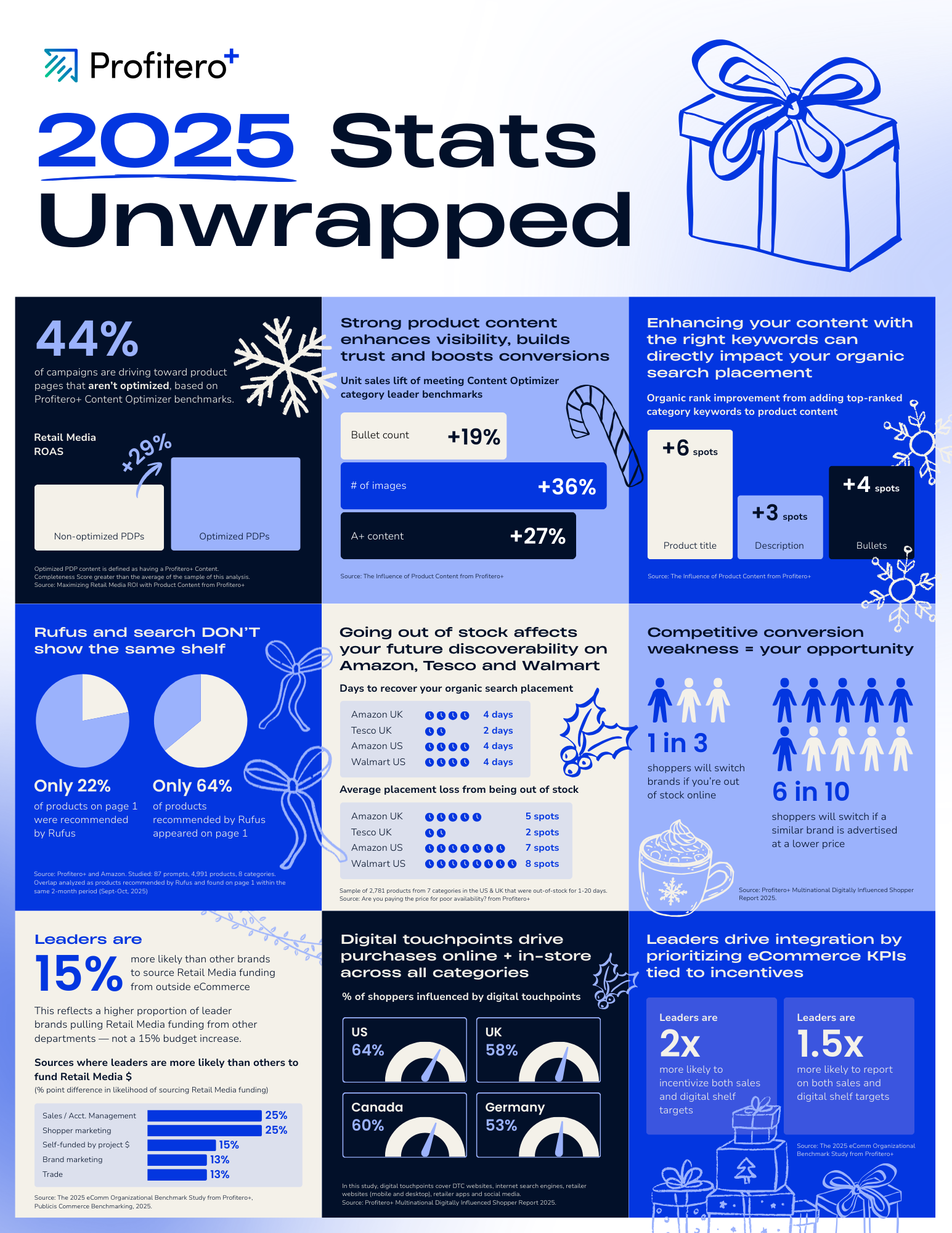
Brands are investing heavily in Retail Media but too often the shopper experience does not match the quality of the investment. Insights from our report ‘Maximizing Retail Media ROI with Product Content’ show that 44% of campaigns send shoppers to product pages that fall short of fundamental content benchmarks such as complete titles, strong imagery and clear bullets.
This creates an immediate performance gap. When shoppers land on pages that lack essential information, they are less likely to buy or worse, choose a competitor, which limits the return on paid investment.
The potential upside is significant: optimized product pages deliver a +29% higher ROAS which proves that Retail Media performs best when it works hand in hand with strong PDP content. When brands pair high quality pages with targeted campaigns shoppers convert more readily - and retail media dollars work harder.
The lesson is simple. Improving PDP content is not only a best practice for organic performance. It is also one of the most effective ways to increase the efficiency and impact of Retail Media spend. Strong content strengthens every click and helps brands capture more value from the budgets they already have.
Strong product content is still one of the most effective ways to improve visibility and conversion. Analysis from our Influence of Product Content report showed us just how powerful foundational improvements can be. Even small upgrades to the basics consistently deliver meaningful sales gains.
Sales uplift from meeting key content benchmarks:
These results make one thing clear. Shoppers reward clarity, completeness and confidence. Pages with the right number of images, bullets and enhanced content do a better job answering questions and reducing uncertainty which drives more conversions. These improvements also strengthen structured data signals that AI-powered product discovery relies on, further boosting visibility and conversion potential.
Because these actions are simple, repeatable, cost-free and within a brand’s control, they also deliver some of the highest ROI on the digital shelf. Brands that consistently meet or exceed these category benchmarks put themselves in a stronger position to increase traffic and grow sales over time.
Our analysis for an upcoming report focused on decoding Rufus recommendability shows a clear disconnect between what searching on Amazon returns and what Rufus recommends. This gap has real implications for how brands think about visibility on the platform.
This means that strong search rank alone no longer guarantees exposure. Rufus is far more selective and is choosing a different set of products based on perceived relevance and individual history instead of traditional search signals.
For brands, this marks an important shift. Success will depend on understanding how AI-powered recommendation systems interpret product quality, clarity and fit for the shopper’s question. Retailers are moving toward answer engines rather than result lists and brands will need to adapt their strategies to earn visibility in both experiences.
Shoppers still rely on search to navigate retailer sites, which means the words you use on your PDP directly influence how often your products are seen. Further analysis from our Influence of Product Content report shows that adding top-ranked category keywords has a measurable and immediate impact on organic placement across multiple content fields.
Organic rank improvement from adding keywords:
These improvements are meaningful because even small jumps in search position can increase traffic and conversion. Products that appear higher on the page earn more visibility, which fuels more clicks and reinforces stronger rank over time.
When a product goes out of stock (OOS) the impact lasts well beyond the immediate sales loss. Retailers penalize unavailable products in their search algorithms which pushes them further down the results page and makes it harder for shoppers to find them once they return.
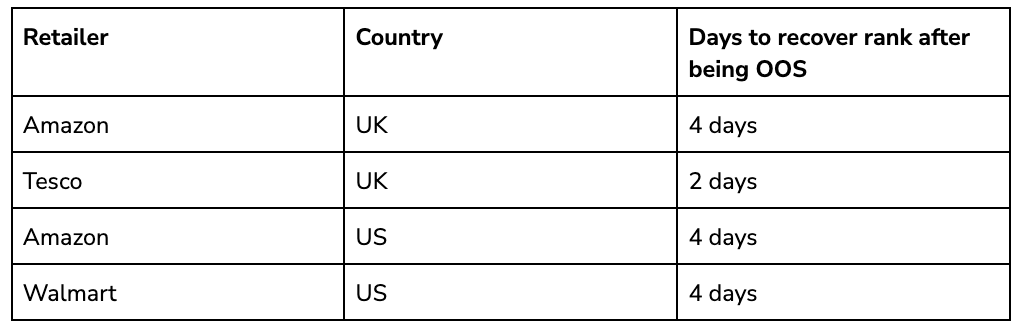
Our availability research showed that it takes days to recover rank after being OOS:
and the average placement lost from being OOS:

These drops in placement matter. Even a small decline in search position from being out of stock can reduce traffic for weeks and slows sales by 62% and makes it harder for products to regain momentum. OOS events also create openings for competitors who may gain rank and visibility while your product is unavailable.
The takeaway is simple. OOS is an SEO issue today and increasingly an AEO (Agentic Engine Optimization) issue in the future. Brands that protect availability also protect discoverability and sales performance in the weeks that follow.
Digital isn’t just a channel; it’s the doorway to most purchase decisions. With 64% of shoppers influenced by digital touchpoints, our 2025 Digitally Influenced Shopper report highlighted price and availability as two of the strongest conversion drivers and shoppers are proving more willing than ever to change their behavior:
For brands, this creates an urgent need to protect shelf presence. Now more than ever, eComm is much bigger than online conversion; it’s now the foundation of product discovery and brand credibility. When shoppers move on quickly, it becomes harder to win them back. Brands that do not keep products available and competitively positioned risk losing loyalty as shoppers choose whatever option is visible and available in the moment.
Analysis from our 2025 eComm Organizational Benchmark Study shows that high-performing eCommerce leaders source incremental retail media budget broadly, across many teams in their organizations. In fact, leaders are 15% more likely than all others to pull Retail Media funding from other departments, creating greater flexibility and enabling them to scale investment when it proves effective. This reflects a higher proportion of leaders pulling Retail Media funding from other departments - not a 15% budget increase.
Brand marketing is the most common source of incremental Retail Media funding among leaders, with 70% of leaders sourcing budget from here; however, the largest gap between leaders and all other brands appears in Sales / Account Management and Shopper Marketing where leaders are 25% more likely to reallocate budget to support Retail Media Investment.
This behavior reflects a fundamental mindset shift: leaders do not treat Retail Media as a siloed budget. Instead, they open more funding pathways and actively reallocate spend toward what works, allowing them to unlock growth faster and more consistently.
Digital is a core part of the buying journey across every major market. Research from our 2025 Digitally Influenced Shopper report shows how many shoppers say digital activity influenced their final purchase decision:
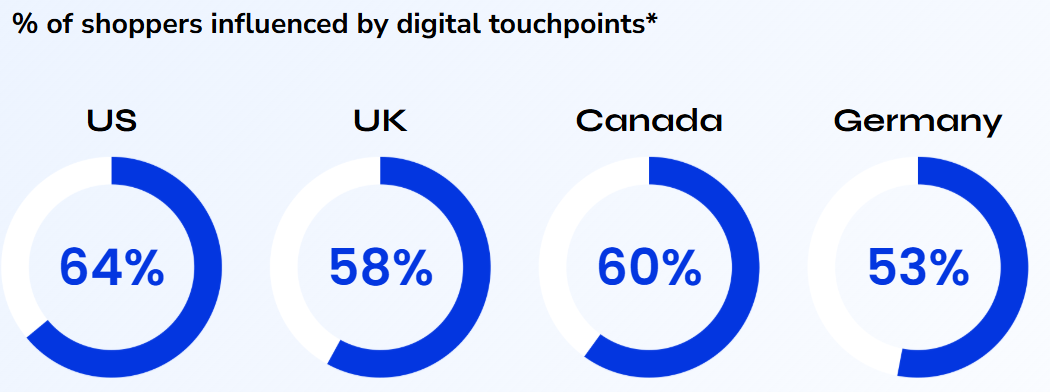
This level of influence shows that shoppers are not simply browsing online. They are forming preferences comparing products and building trust long before they get to a shelf. Retailer sites, search engines, AI assistants, brand content and social media all play a role in shaping what shoppers believe and ultimately buy.
For brands, this means digital shelf execution is no longer a support function. It is a primary driver of both online and in store sales. Strong product content, clear imagery, complete information and high visibility across search and retail media directly shape conversion outcomes. When digital touchpoints carry this much weight, brands that invest in quality and consistency across channels will win more often and with greater efficiency.
Shoppers no longer research digitally. They decide digitally.
Our 2025 eComm Organizational Benchmark Study showed that organizational alignment is quickly becoming one of the strongest predictors of digital success. The brands that win are the ones that connect daily execution to clear, measurable goals and then reward teams for achieving them.
Our analysis shows a meaningful gap between leaders and all other brands:
This connected approach matters. When teams are measured only on sales, they focus on short term results and miss the foundational drivers that fuel long-term growth - especially in a world where the digitally influenced shopper journey makes search visibility and content critical contributors to conversion. When they are measured only on digital shelf health, they risk optimizing for visibility without tying actions back to business outcomes.
Leaders close this gap. They give teams a clear understanding of how content, availability, search performance and retail media all ladder into revenue. This encourages smarter prioritization, faster collaboration and a shared commitment to building sustainable omnichannel performance.
Incentives shape behavior. Leaders use them to pull the entire organization toward a unified goal and it shows in the consistency and strength of their execution.
As we look ahead to 2026, we expect continued focus on content quality, discoverability and the ability for organizations to adapt quickly.
Agentic commerce has begun to take shape this year, with many brands starting to think about what it could mean for how they plan, operate and show up across the digital shelf.
At a practical level, readiness for this next phase is grounded in having a strong digital shelf foundation and gradually evolving toward more connected, data-informed and AI-aware ways of working across teams. These are not overnight changes, but important building blocks for the future.
For those who want to take a closer look at where their organization stands, we’ll be spending time early in the new year exploring Agentic Commerce Readiness and what it can look like in real-world scenarios in our upcoming webinar, How to Evolve Your Digital Shelf Playbooks for A.I. Commerce.
Thank you for another year of partnership, collaboration and shared learning.