
Menu

Amazon Best Seller Rank (BSR) is the platform’s primary indicator of how well a product is selling within its category. Updated frequently and based on recent purchase activity, it reflects which products shoppers are consistently choosing. For brands, it has long been one of the clearest signals of marketplace success.
For years, achieving a strong BSR followed a familiar playbook: win search visibility, drive traffic, maximize conversion and invest aggressively in retail media. Generate enough demand, build a compelling PDP and a stronger sales rank would follow.
As Amazon and shoppers increasingly rely on AI systems to guide product discovery and recommendation, the role of BSR is evolving. A strong sales history does more than reflect past demand. It produces the behavioral signals Amazon’s models use to interpret shopper behavior and determine which products they can confidently surface.
Amazon’s AI assistant Rufus (also known as Alexa for Shopping) provides a clear example of this shift. Our analysis in a research study shows that products appearing in Rufus responses tend to have significantly stronger sales performance. On average, they hold a Best Seller Rank roughly 2.5× stronger than comparable products that do not appear as often.
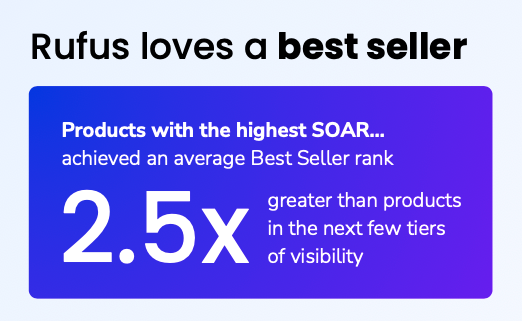
SOAR = Share of Agent Recommendations
Amazon’s own engineering research on the COSMOS LLM model offers additional context. Although the work was not written for brands, it sheds light on how recommendation models operate. Rufus relies on behavioral signals such as search-buy and co-buy activity to determine which products are eligible for recommendation.
Search-buy signals capture what customers purchase after entering a specific query, for example, if a high proportion of shoppers who search “gaming laptop” go on to buy a particular model, that product strengthens its association with that search. Co-buy signals reflect which products are frequently purchased together within the same journey, such as a laptop and a laptop sleeve.
Together, these signals help Amazon infer both customer intent and product relationships. Products with insufficient signals are filtered out early to reduce noise, meaning items without enough shopper interaction are less likely to be surfaced in recommendations.
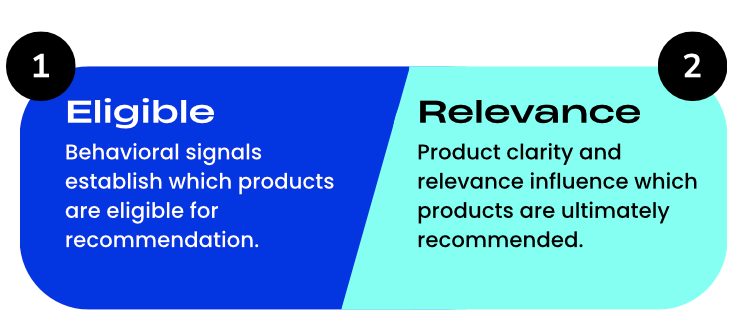
This creates a two-stage dynamic within Amazon’s AI discovery systems. Behavioral signals establish eligibility. Product clarity and relevance influence which products are ultimately recommended. The products that rise to the top are those Amazon’s models can both interpret clearly and trust to satisfy shopper intent.
In this environment, best-seller status is best understood as an outcome rather than a tactic. It reflects how well a product aligns with the signals and product understanding that Amazon’s AI models use to guide purchasing decisions.
As Amazon’s discovery systems become more intent-driven, brands need a clearer framework for deciding where to focus. The goal is not to chase every optimization opportunity, but to align effort behind the signals that most influence recommendation and sales momentum.
A useful starting point is to anchor strategy to a North Star metric. For most brands, that will be closely tied to profitable growth—whether that is share of category sales, contribution margin, or another commercial outcome. Priorities across content, media and operations should ultimately support this objective. Without that alignment, optimization efforts can easily drift toward tactical improvements that have limited impact on overall performance.
Once that North Star is defined, there is a two-stage execution for getting ready for the future of AI-driven discovery.
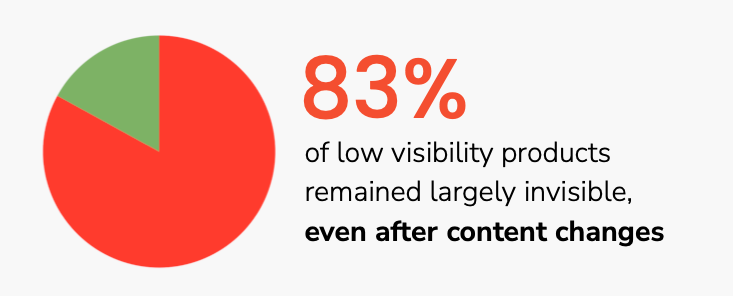
Across our Decoding Rufus study, one factor stood out: You can’t tweak your way into AI recommendations. We partnered with 8 brands (and optimized 45 products) to test whether prompt-based content improvements drive measurable gains in retailer AI recommendations. Through this research, we found that products in the test group that were not initially recommended by Rufus typically did not surface even after content optimization. In other words, minor content improvements alone did not immediately change the product’s recommendability.
For that reason, the most reliable path to stronger discovery is still the one sellers have known for years: get the fundamentals of the digital shelf right.

Operational execution and listing quality continue to have measurable impact:
None of these factors alone guarantees recommendation. Together, they create the behavioral signals Amazon’s models need to interpret a product with confidence.
The fundamentals do not just improve conversion. They generate the signals that make optimization possible in the first place.
Product discovery is no longer driven solely by keyword matching. While search terms still matter, retailer AI systems such as Rufus focus on interpreting the intent behind a shopper’s request.
A traditional search query like “running shoes” relies on keyword alignment between the query and a product listing. Rufus operates differently. When a shopper asks a question such as “show me the best running shoes for long distances” the system attempts to interpret the need behind the request and identify products that best satisfy it.
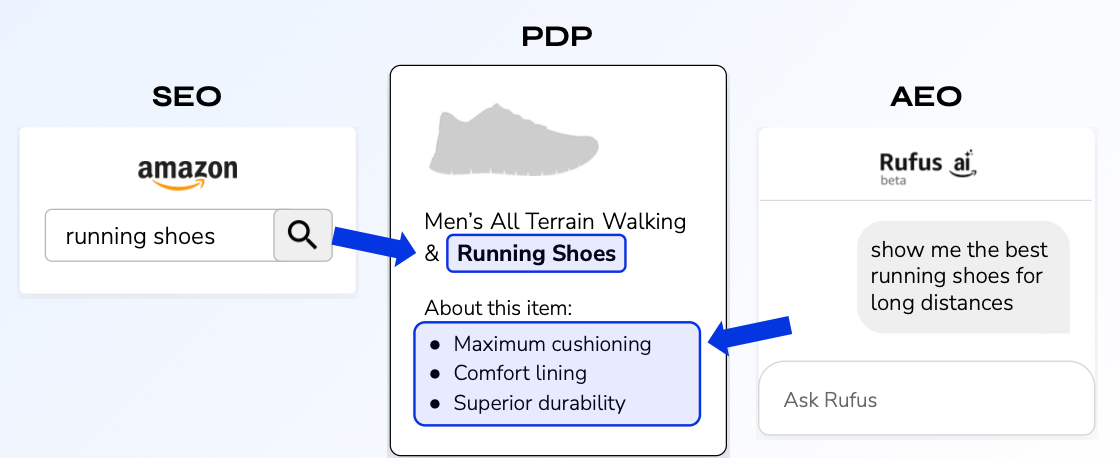
To do this, Amazon’s models analyze behavioral patterns across the marketplace, including:
These signals allow Amazon to infer intent and match products to the situations shoppers are trying to solve.
As discovery becomes more intent-driven, the products that perform best are those Amazon’s systems can interpret with confidence. In practice, this means strong sales rank increasingly reflects not only demand generation, but how clearly a product communicates its role in solving a shopper’s problem. This is particularly true in environments shaped by simpler, more general prompts, where recommendation systems tend to rely more heavily on broad signals like Best Seller Rank.
Not all prompts are equal; they exist on a spectrum, ranging from broad, generic queries (like “What’s the best sunscreen?”) to highly specific need-state questions (such as “What’s the best sunscreen for a 10-year-old boy with fair skin traveling to Hawaii?”). The level of detail materially changes how an agent interprets relevance.
As prompts become more specific, relevance signals shift from general popularity toward precise attribute matching.
And in a world where AI increasingly guides discovery, clarity is the most scalable advantage you can build.
Want to understand how we help brands win visibility in the age of AI?
Profitero+ Advisory team is helping brands to unlock growth through clarity on their AI strategy. From prioritising AI-driven work flows to driving greater AI search visibility, our team is ready to help, so let’s talk!
https://www.profitero.com/solutions/ai







.png)