Menu
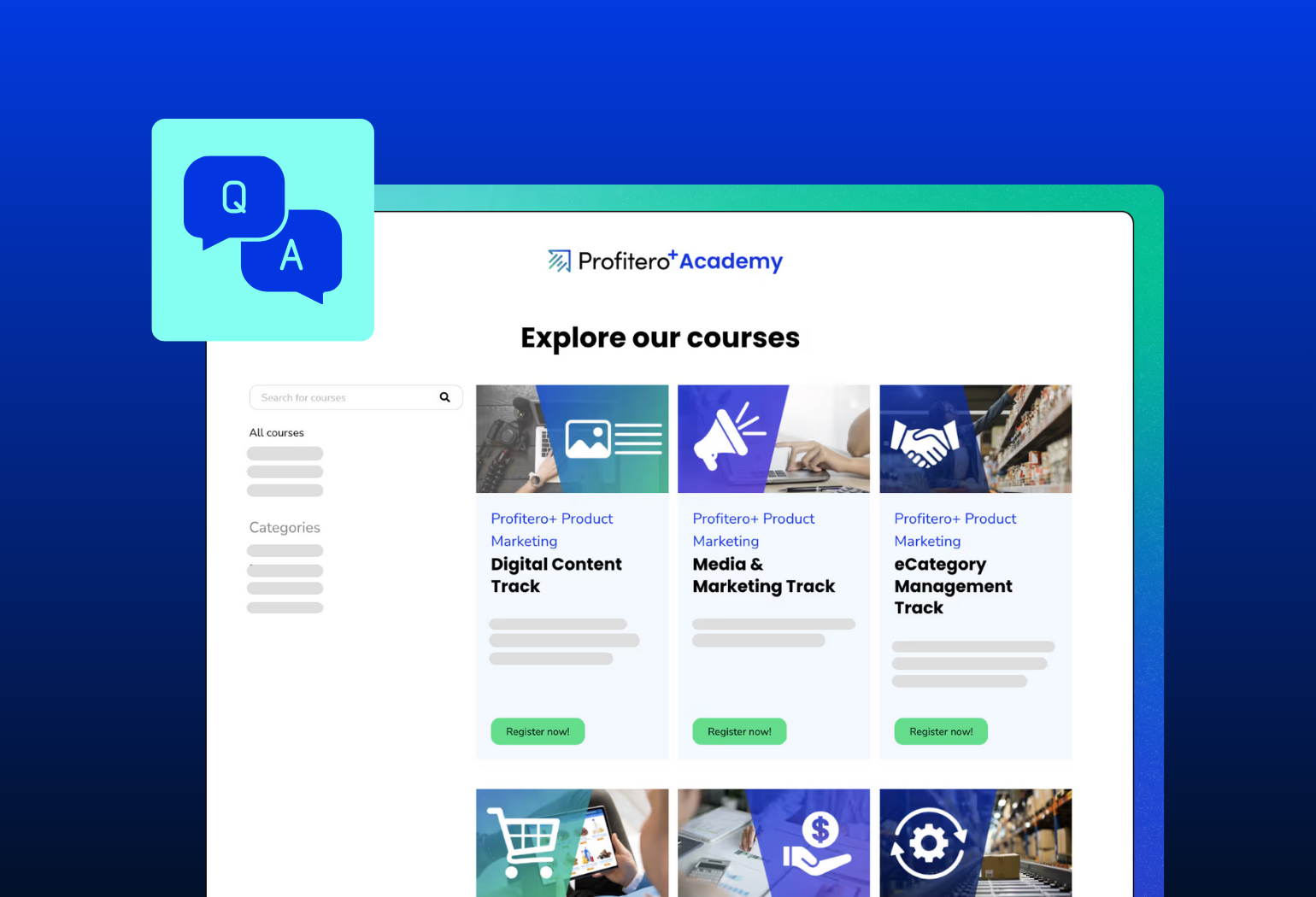
As we head into 2026, the competitive advantage in eCommerce has shifted from who has the most data to whose team can execute on it with the most precision. To maximize and scale omnichannel performance, leaders must move beyond static reporting and empower their teams to take decisive action.
We sat down with experts Daniel McIntosh, VP, Customer Success, EMEA & APAC, and Katie Tateishi Wall, VP, Customer Success NA, to discuss why Digital Shelf Certification from Profitero+ is worth the time investment. In this interview, they answer the 10 critical questions every leader must ask to eliminate knowledge silos and ensure their 2026 strategy is built on a foundation of expert execution.

Daniel McIntosh
VP, Customer Success, EMEA & APAC, Profitero+
It’s simple: certification empowers users to turn Profitero+ from a data source into an action engine. Certification helps clients hit the ground running by giving teams a strong foundation in how the platform works and, more importantly, how to use it to answer the most critical performance questions.
In practice, we consistently see a clear pattern: the more users that are certified, the more the platform is used; the more it’s used, the more measurable improvements in digital shelf metrics such as availability, content quality and brand compliance. Those improvements are the direct drivers of increased sales. Availability is a simple example: once teams understand how to identify an availability issue in Profitero+, they can act quickly, recover lost sales and prevent repeat issues.
Ultimately, ROI comes from action—but action depends on understanding. Certification is the leading indicator of ROI because it ensures teams know where to look, what to prioritize, and how to use Profitero+ data to make better, faster, data-informed decisions.

Katie Tateishi Wall
VP, Customer Success, NA, Profitero+
ROI (again). Full stop.
When teams are just reporting data—building decks, pulling dashboards, sharing screenshots in QBRs, etc.—you're paying for documentation. The value comes when data drives actual business outcomes: recovering revenue from out-of-stocks, fixing content that lifts conversion, reallocating retail media spend to higher-performing ASINs. The difference isn’t the data—it’s how the people use it. Certification trains teams on how to interpret signals, prioritize opportunities and act with confidence, so insights don’t stall at reporting.
I've seen this firsthand. Before certification, teams would present data in meetings and wait for someone to tell them what to do. After certification, those same teams show up with the insight already translated into an action plan: "We identified $2M in at-risk revenue from content gaps, here's how we're fixing it, here's the timeline and here's how we'll measure impact."
That changes the relationship between data and results. Instead of hoping the data will point to something useful, you're systematically turning insights into revenue. For leadership, that means you can finally answer: "What are we actually getting from this software?" And the answer is measurable business impact, not just better reporting.
Daniel Mcintosh
When users are certified, they’ll be more efficient, knowing where to start and where to focus.
Our certification program is built around distinct customer jobs-to-be-done; each certification track is highly practical, with step-by-step guidance on how to do specific tasks and why they matter. This gives teams a clear benchmark for what “good” looks like at every stage of e-commerce maturity.
And because we work across multiple verticals and brands, the program is informed by what we know consistently drives results in the real world—not theory.
Katie Tateishi Wall
That's why we broke this into 5-minute lessons. The longest course is maybe 90 minutes total, but you can get through it in chunks. New hire starting Monday? They can complete the foundational digital shelf training before their first week wraps. Experienced person who just needs a refresh on retail media? They can hit exactly the module they need without sitting through content they already know.
For my teams, this has been a game-changer during onboarding. Instead of waiting weeks to get someone productive, they're contributing to strategy conversations within days. And for people who've been here a while, it's a just-in-time resource they can reference when they need it—not a compliance thing they resent having to do.
Daniel Mcintosh
The most compelling reason to prioritize certification now is that it immediately drives better performance - and who doesn’t want to reach their Q1 KPIs?
We consistently see that when clients complete certification see improved scorecard performance, stronger adherence to brand guidelines and ultimately positive revenue impact.
Certification tackles the harder, foundational work teams often delay, but that foundation is exactly what unlocks faster wins later. By investing the time now, clients start 2026 off aligned, confident in how to use the data and focused on the actions that move the needle—rather than spending Q1 figuring out where to even start.
Katie Tateishi Wall
I see this all the time across accounts. The Amazon team is optimizing in one direction; the omnichannel team is pulling another way - and neither are talking to each other. Or Sales is focused on velocity, Category Management is worried about assortment and eCommerce trying to fix content—but nobody's aligned on what "winning the digital shelf" actually means.
The role-based structure creates a common framework and shared language across these teams. Instead of everyone sitting through the same generic training on every product feature—which leads to people zoning out—each role gets exactly what they need to do their job. Your eCommerce manager learns how to act on insights daily, while your Category Manager understands how digital shelf data informs assortment decisions.
What this means in practice: when your Amazon team spots a pricing gap and your retail team sees the same pattern at Target, they're both working from the same playbook. That alignment is what turns scattered insights into coordinated action that actually moves the business forward.
Daniel Mcintosh
Yes, it’s critical! eCommerce certification is essential for adjacent stakeholders because it creates a shared, omnichannel understanding that improves collaboration, planning and execution.
Today’s consumers don’t distinguish between online and offline—every touchpoint contributes to a single brand experience. Certification provides adjacent teams a practical understanding of what e-commerce data is available, how it’s used and how it connects to their own objectives.
For Brand teams, certification builds awareness of the digital shelf as a critical part of the brand experience. It helps them understand how brand guidelines, content and compliance are executed online—and where gaps exist—so they can ensure consistency and quickly address issues that impact consumers.
For Supply Chain teams, certification helps close feedback loops that are often invisible. Signals like availability issues, incorrect products or negative reviews highlight breakdowns between the digital promise and the product delivered.
Ultimately, certification acts as an icebreaker and alignment tool: it equips adjacent stakeholders with a common language for eCommerce, supports omnichannel decision-making, and ensures teams are working together to deliver a consistent, high-quality consumer experience. And that shared knowledge - of an end-to-end omnichannel experience - enables more effective business planning.
Katie Tateishi Wall
Digital shelf and eCommerce analytics are exploding career fields, but there's surprisingly little standardized credentialing. Most people learn on the job, piecing together knowledge from different platforms. Having a recognized certification in Digital Shelf strategy immediately sets you apart.
From a hiring perspective, this signals two things: you've invested in specialized expertise in a high-growth area and you understand eCommerce strategically, not just tactically. That matters whether you're an analyst trying to move into management or a director positioning for a VP role.
The badge becomes visible proof on LinkedIn and resumes that you have verified expertise. In a market where everyone says they "know Amazon" or "understand digital commerce," having a credential that backs it up cuts through the noise. And honestly, as this space continues to mature, early adopters of certification will have a leg up as standards evolve.
Daniel Mcintosh
Certification helps to democratize and institutionalize eCommerce knowledge instead of letting it live with a few individuals or centers of excellence (COEs).
As many organizations disband dedicated eCommerce centers of excellence, responsibility is increasingly distributed to category managers and commercial teams who now own omnichannel performance alongside their offline roles. Without structured enablement, critical eCommerce knowledge is lost every time someone leaves—and new team members struggle to understand why eCommerce matters to their remit.
Certification provides a consistent, role-based foundation that quickly onboards new team members and ensures everyone understands what’s most important, how to influence the digital shelf and where to focus their time for impact. Instead of relearning through trial and error, teams inherit a proven framework for decision-making.
The result is faster ramp-up, better decisions and continuity of performance—even as teams change—because eCommerce expertise becomes embedded in the organization, not dependent on any single person.
Katie Tateishi Wall
Here's what I've learned managing enterprise accounts: knowing which buttons to click doesn't make you strategic. Traditional training stops at "here's how to pull a report" without ever connecting it to why that report matters or what decision it should drive.
High-performing teams understand the context behind the data. When someone knows that share of search isn't just a metric to report out—but actually a leading indicator for market share shifts and a signal for where to invest in retail media—they stop presenting numbers and start driving outcomes.
This training connects the "what" to the "why." So instead of saying "our content score dropped," your team is saying "our content score dropped, which means we're likely losing share to competitors, and here's the plan to fix it." That shift from reactive reporting to proactive planning is what makes your investment in both the platform and your people worth it.

Interested in learning more about the Profitero+ Academy certification? Invest in you – learn more here.