Menu
Effective use of digital shelf analytics goes further than a performance dashboard and bridges the gap between search, content and discoverability signals with retailer, media and sales data so teams can understand what changed, why it changed and where to act next.
Most brands have access to a bounty of data, but few have successfully operationalized it across the business to turn data into action.
That challenge was at the center of a recent webinar I led, Connecting the Dots: From Data to Decisions, where I was joined by Amy Sillince, Global Head of Conversion at Opella and Ben Galvin, Sr. Director of Omnichannel Retail Sales & eCommerce at Monster Energy. Together, we explored how enterprise CPG organizations are using digital shelf data to improve decision-making, align teams and connect eCommerce performance back to growth.
Here are five takeaways from our discussion.
Enterprise CPG organizations have access to hundreds of eCommerce metrics. The hard part is deciding which ones actually deserve attention.
For both Opella and Monster Energy, sales remains the ultimate North Star. But digital shelf metrics can provide teams with leading indicators they can influence before the final sales result appears.
At Opella, for example, the organization uses its global Profitero score as a proxy for overall digital shelf performance.
As Amy articulated on the webinar,
“Our real North Star is eCommerce net sales, but that doesn’t really speak to how we actually get there. We needed something that would help the whole organization understand what drives those net sales.That’s why we selected our global Profitero score. It’s a roll-up of all our other scores, but also reflects performance across all the countries where we operate."
.png)
Amy shared that the metric has become relevant beyond the eCommerce organization, helping the company create greater alignment around digital performance.
The takeaway: Establishing your North Star is the first step, but to maximize your opportunity to grow, you need to understand and track the signals that ladder up to it.
For Monster Energy, a major focus is whether products show up where consumers are actually looking for them.
The team uses Profitero+ data to measure share of search across category and branded keywords, helping them understand digital discoverability across retailer environments.
.png)
Monster has aligned around a focused set of Profitero+ driven metrics tied to discoverability and visibility, then extended that thinking into newer areas like AEO and AI-driven product discovery.
For Opella, content is another critical piece of the equation. With more than 100 brands and products that require shoppers to evaluate detailed information, strong PDP content directly supports conversion.
Amy put the relationship simply:
“Content score means conversion rate goes up, means sales go up.”
That gives Opella a clearer way to demonstrate why content optimization matters to brand teams that may not be eCommerce experts themselves.
Why it matters: Search visibility and content performance aren't isolated digital shelf metrics. They help brands understand whether products are being found, evaluated and ultimately purchased, while giving other teams better signals to inform marketing, sales and media decisions.
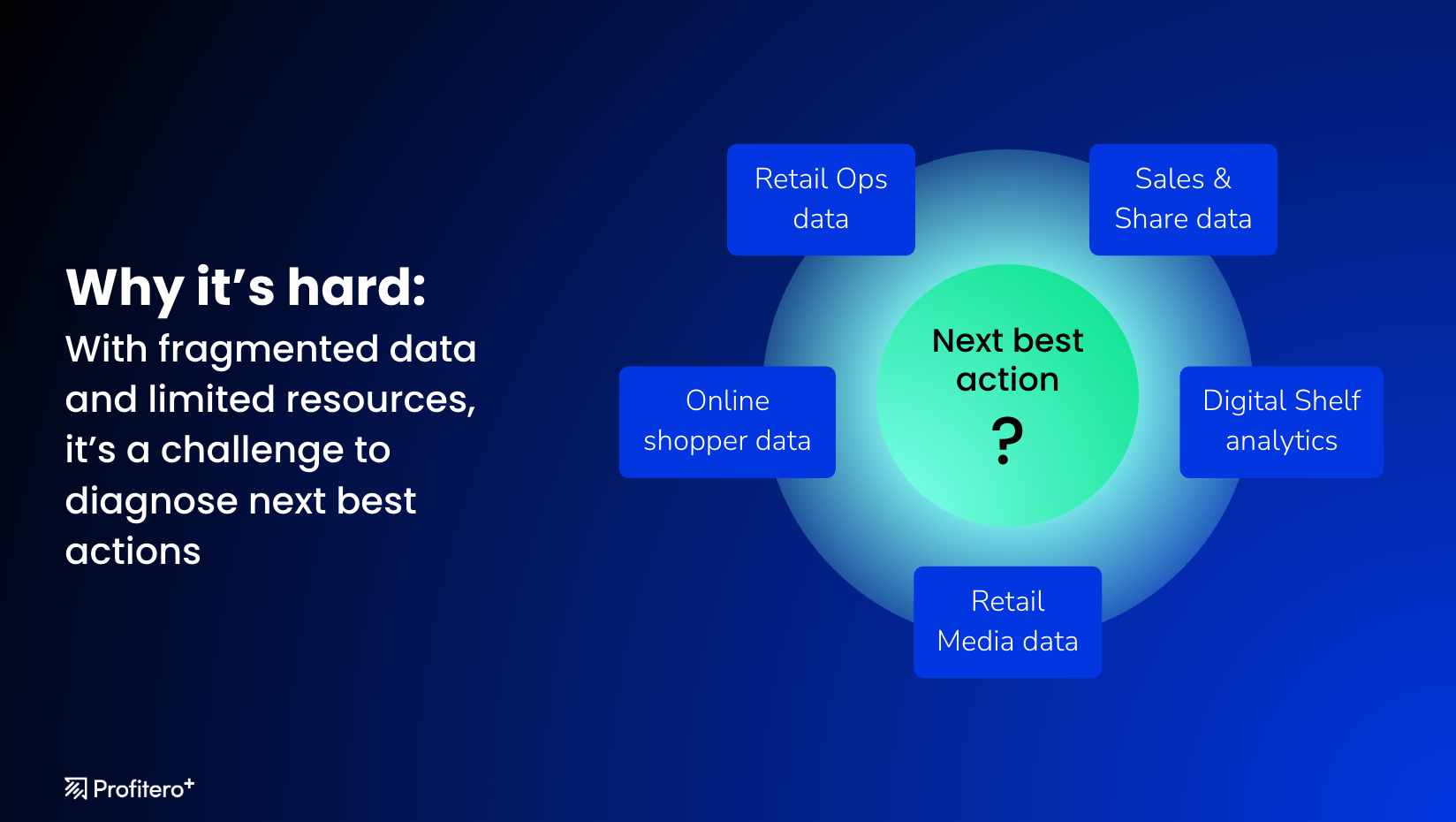
The deeper opportunity comes when digital shelf data is connected with other signals across the business.
Opella is bringing together digital shelf signals, retailer sales data and granular retail media data to get a much clearer picture of performance.
With those datasets connected, teams can drill down to the SKU and day level and ask more specific questions: Was a performance change driven by pricing? Search visibility? Content? Media?
That makes it easier to diagnose the problem before deciding where teams should spend their time.
Monster is taking a similarly connected approach. The team brings Profitero+ search and content metrics into regular conversations with sales, marketing, category leadership, shopper marketing and paid search teams. Profitero+ data is also being used alongside master data and internal optimization tools to create a broader view of discoverability.
Why it matters: To get the most out or their data, brands in-depth digital shelf analytics should connect signals so teams can understand what changed, why it changed and what they can do about it.
A trusted source of truth is essential, but it only gets teams so far. A dashboard without action is still just a collection of numbers. The real value comes when teams use that shared view of performance to inform decisions, prioritize opportunities and measure what happens next.
Ben argues that the more useful goal is a “single source of action.”
.png)
At Monster, that means connecting search signals, retailer keyword data, LLM visibility and other inputs so teams can identify what they can influence, take action and measure whether it worked.
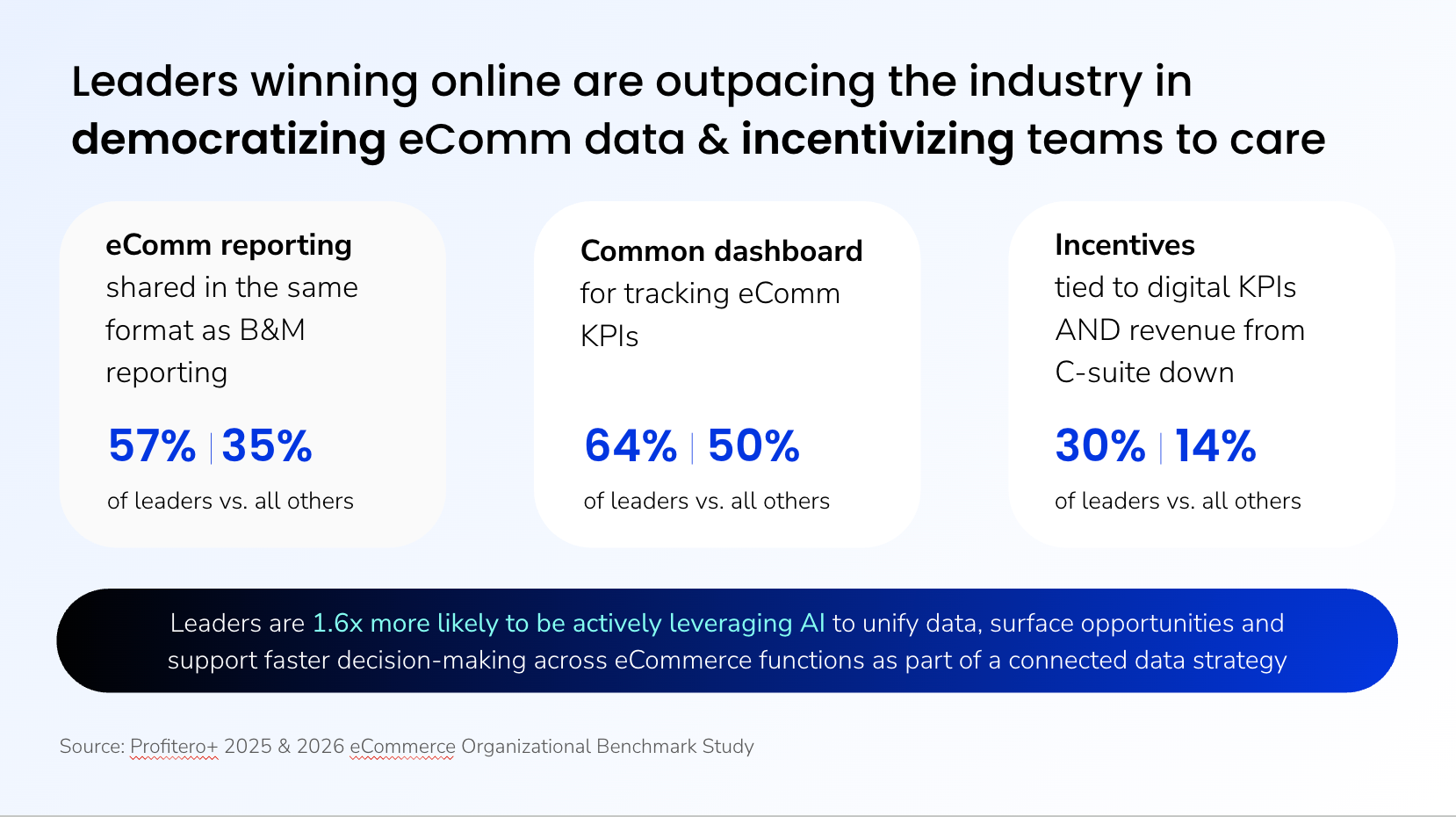
Our 2026 eCommerce Organizational Benchmark Study shows the same pattern at a broader industry level. Leaders are more likely to use common dashboards to track eCommerce KPIs (64% vs. 50%), align eCommerce reporting with brick-and-mortar reporting (57% vs. 35%) and tie incentives to digital KPIs and revenue from the C-suite down (30% vs. 14%). Leaders are also 1.6x more likely to actively leverage AI to unify data, surface opportunities and support faster decision-making as part of a connected data strategy.
Data and technology can be accelerators, but unless brands build out the structure and capabilities to act, they will find themselves limited by low adoption.
At Opella, Amy pointed to two principles that have helped bring more of the organization along: simplicity and repetition. That means simplifying KPIs, giving teams a clear set of actions and repeating the same story across brand, regulatory, training and other functions.
Why it matters: Digital shelf analytics create more value when the insights don't stay within eCommerce. Making the data understandable and actionable helps more teams use it to make decisions.
Digital shelf management is expanding.
Brands still need to win traditional retailer search and PDP conversion, but consumers are also discovering and evaluating products through AI assistants and other emerging experiences.
For Ben, that means even familiar digital shelf metrics like share of search will need to evolve as the way shoppers discover products changes.
For Amy, the end goal is even more actionable: using connected data and AI to help teams determine what they should actually do next.
.png)
That idea is already shaping the work our Advisory team is doing with brands through eCommerce Data Operationalization (EDO): helping teams connect the right signals, focus on the metrics that matter and prioritize the next best actions for the business.
Instead of asking teams to manually work through every possible opportunity, the goal is to make it easier to identify and act on the opportunities most likely to make an impact.
More data is rarely the solution, especially in an industry where leaders are continually told to do more with less. The real unlock will come when brands commit to evolving their data strategy to every metric has an owner, and more importantly, a purpose.
Profitero+ helps enterprise CPG organizations measure digital shelf performance across areas like search, content and discoverability, then bring those insights together with the broader business context needed to make decisions. Our Advisory team also helps brands operationalize eCommerce data by connecting the right data, focusing teams on the metrics that matter and building the behaviors needed to act on them.
As I summarized at the end of the discussion:
.png)
Watch Connecting the Dots: From Data to Decisions on demand to hear our full conversation and learn how leading CPG teams are turning connected eCommerce data into action.